
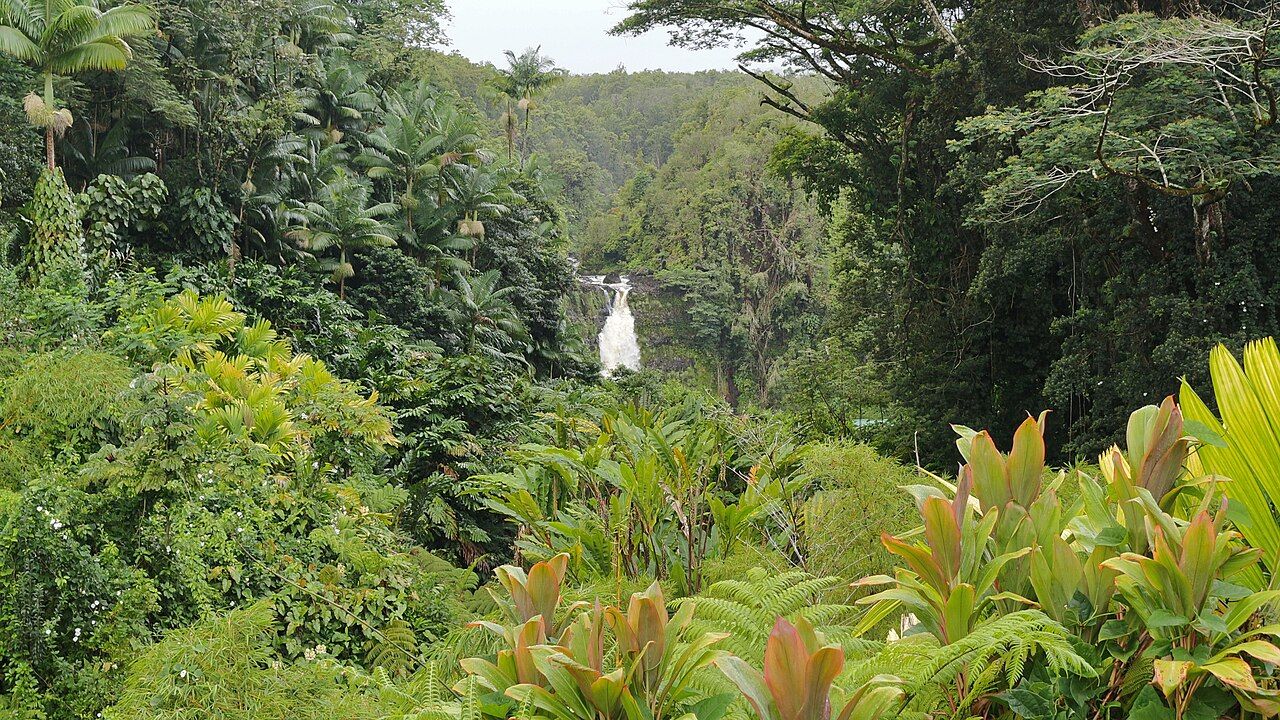
1. Why start with the water?
Hilo gets its rain from the trade winds, and the water keeps moving after the clouds pass. It runs off Mauna Kea and Mauna Loa, cuts through the eastern slopes in deep gulches, then heads toward the sea.
That gives the town two very different places to watch a river fall. Rainbow Falls sits within Hilo, close to downtown, while ʻAkaka Falls is farther north along the Hāmākua coast. Neither asks for a long hike, and they make a satisfying pairing before the rest of a volcano day.
I’d give the morning to the waterfalls rather than squeeze them into a hurried stop. Clouds tend to gather over the windward side as the day goes on, so the earlier hours usually offer clearer views. Start at Rainbow Falls, then point the car north while the sun is still low over the ocean.
2. What does Rainbow Falls look like from the rail?
Rainbow Falls is on the Wailuku River, in a small section of Wailuku River State Park. From the parking area, a short path leads to a railed lookout above the pool. The water pours over an old lava ledge into a wide, round basin, and most days the whole drop looks broad and loud.
Waiānuenue, the Hawaiian name for the falls, means rainbow seen in the water. On sunny mornings, spray rising from the pool catches the light and can throw a bow across the basin. The arrangement is simple: sun behind, mist ahead. With that in place, the rainbow has a chance to show; later, it fades, leaving the waterfall itself.
There’s a cave behind the curtain of water, told in Hawaiian tradition as the home of Hina, mother of the demigod Māui. It belongs to the story of the place, not to a path to pursue. The lookout is the right way to take in both the falls and the cave.
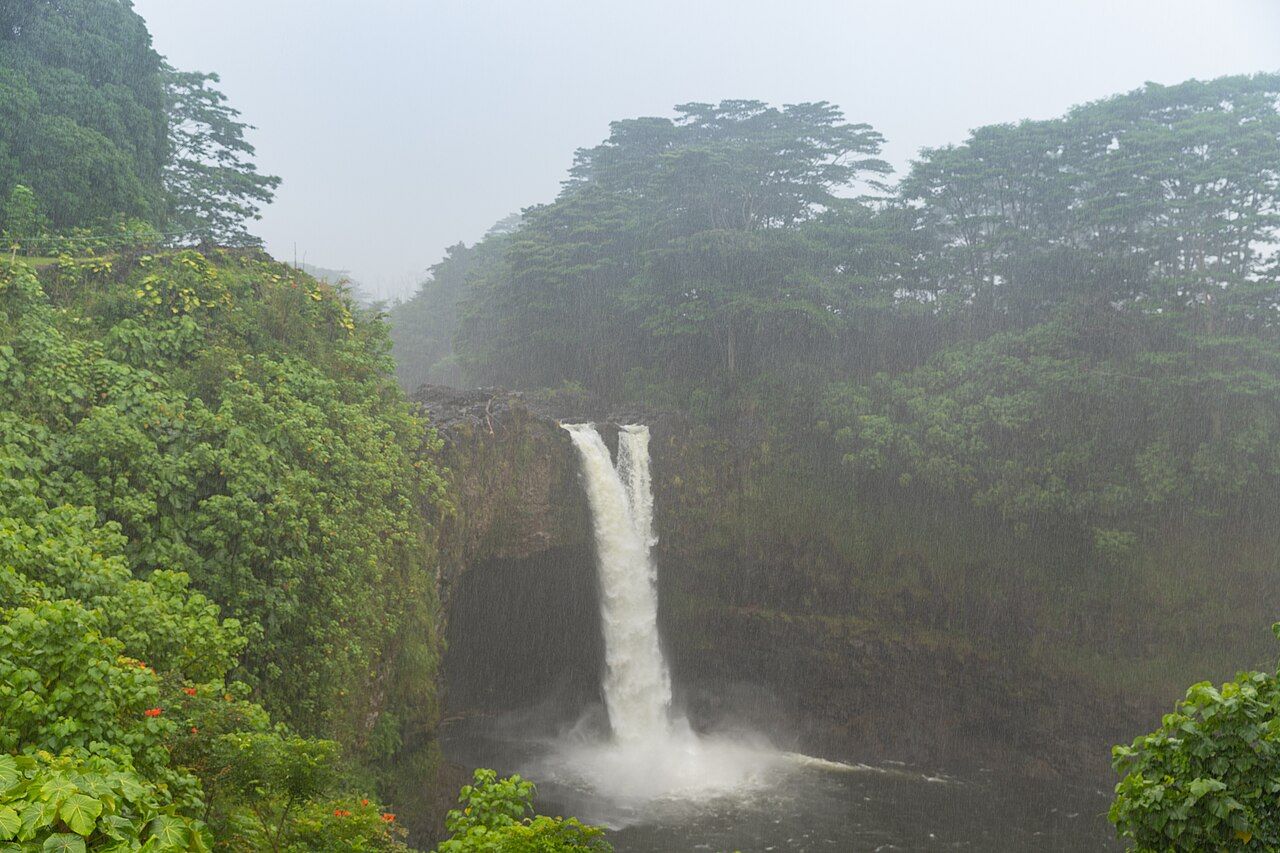

Steps to the left climb to a higher view and a huge banyan whose roots rise like walls. From up there, the river’s course is easier to read, and the top of the falls comes into view. I like the lower lookout best, though; the pool and the noise of the drop are the main event.
3. What’s happening upstream?
A little farther up the Wailuku River, another lookout faces the Boiling Pots, a series of pools that churn as water rushes through cracks in the lava. The name fits the restless surface, but it’s only a view, not an invitation into the river.
The current is strong, and rain falling upslope can raise the river quickly, even when Hilo itself has blue sky. From the lookout, the pools offer a lively contrast to the wide drop at Rainbow Falls. Stay on the viewing side and let the water do its own thing.
4. What changes on the drive north?
Highway 19 leaves Hilo heading along the Hāmākua coast, through steep gulches, green pasture, and old sugar country. Cane covered much of this district for about a century; the plantations have closed, and the drive now passes small farms, forest, and the occasional mill chimney.
Just north of town, a turn leads to the old scenic route above Onomea Bay. It’s narrow, dipping through gullies beneath a roof of trees, with small one-lane bridges along the way. The road rejoins the highway a few miles farther on, so the detour adds only a little time, but it changes the feel of the drive.
Ease across the bridges, yield to traffic coming the other way, and leave room for people on foot. Then continue north to Honomū, where the turn for ʻAkaka Falls leaves the highway. The road climbs inland through farmland and ends at the state park.
Read next: Hilo, where the bay keeps its own time
There’s room to make this a Hilo outing rather than a waterfall dash; a slow wander around Hilo's bayfront and gardens fits naturally beside the river. The town and the coast make a good pair, with the drive between them giving the morning its shape.
5. What does the ʻAkaka loop reveal?
ʻAkaka Falls is much taller than Rainbow Falls, dropping more than 130 metres in a single ribbon into a gorge lined with trees and ferns. The park is small, and its paved loop is less than a kilometre long, taking visitors through rain-forest plants to the main viewpoint and back.
The loop has steps, so it isn’t flat, but it’s short enough to keep the walk focused on what grows around it. Go either way. Bamboo groves, giant philodendron leaves, wild ginger, and heliconia form a dense green tunnel, much of it planted long ago and now grown together.
Kahūnā Falls appears through the trees along the route, partly screened by the forest. Then the gorge opens, and ʻAkaka drops straight down a sheer wall to a pool that can’t be reached. This is my favorite view of the pair: the sudden scale of the gorge makes the short walk feel like it has been leading somewhere all along.
After heavy rain, the falls become a roaring brown column. Following a dry spell, they narrow to a white thread. The water changes its character, but either version is worth the walk; the forest is part of the visit, not just a corridor to the main overlook.
6. How do rain and light shape the morning?
At Rainbow Falls, the morning sun gives the rainbow its chance. At ʻAkaka, light reaches into the gorge before afternoon cloud rolls over the coast, and the paths are quieter. That’s why I’d visit the river first, then carry on north rather than reverse the order.
Rain is ordinary on this side of the island, not a reason to write off the day. A wet morning swells the falls and leaves the forest full of dripping sounds. A light rain jacket works better than an umbrella on narrow steps, and insect repellent helps on the damp ʻAkaka loop.
The trip crosses a change in elevation and weather if it begins at Volcano. The village can be cool and misty in the morning, while Hilo and Hāmākua feel warm and humid. A layer that can come off, shoes with grip on wet steps, and a dry shirt for the drive home cover that change without much fuss. The notes on rain, cold nights and what to pack add more about the windward side.
7. What manners belong at the falls?
Stay behind the rails and on the paths. Plants grow fast here, but ground trampled off the trail can erode in the next storm. Keep out of the streams, too: flash floods can arrive from rain far upslope, without warning at the falls themselves.
Leave flowers and stones where they are, and give other visitors room in the small parking areas. Don’t block driveways along the access roads. Lock the car, and tuck valuables somewhere they can’t be seen.
At Rainbow Falls, the marked viewpoints keep the walk straightforward, but the edges can be slippery and the river is more powerful than it looks from above. At the Boiling Pots, the lookout is the place to stay. These aren’t fussy rules; they let the water and the paths remain the focus.
8. How does this fit into a volcano trip?
From Volcano village, the drive down Highway 11 to Hilo takes around three quarters of an hour, and ʻAkaka Falls is roughly half an hour beyond town. Rain and slow traffic can stretch the drive, but the loop from the village to Rainbow Falls, onward to ʻAkaka Falls, and back makes a comfortable half day.
If there’s more room in the day, continue north toward the Waipiʻo valley lookout, where the Hāmākua road runs out above one of the island’s great valleys. For a longer circuit around the island, the notes on driving around the island help put the distances in context.
A few useful details
- Rainbow Falls is in Wailuku River State Park, a few minutes from downtown Hilo.
- ʻAkaka Falls State Park charges entry and parking fees, with different rates for residents and visitors.
- Bring a rain jacket, grippy shoes, insect repellent, and small change.
- Give the falls a clear morning, when the views are usually clearest and Rainbow Falls has a chance to show its namesake.
Rainbow Falls has my favorite view, but ʻAkaka’s gorge is the walk I’d happily take twice.