
1. What waits below the road in the morning?
The path drops from the road into a small crater, where tree ferns crowd the slope and a little bridge leads toward Nāhuku’s dark entrance. This is a wet, green corner of the park; moss clings to surfaces, and ʻōhiʻa trees rise above the fern canopy. I like that the forest gets the first word, before the tunnel narrows the view.
The cave’s other familiar name is the Thurston lava tube. A publisher and businessman who promoted the volcano as a destination was shown the tube in 1913, and the park now puts Nāhuku, its Hawaiian name, first. It’s among the park’s most visited stops, though the quiet hours can make the place feel wonderfully unclaimed.
2. How did a river of lava leave a tunnel?
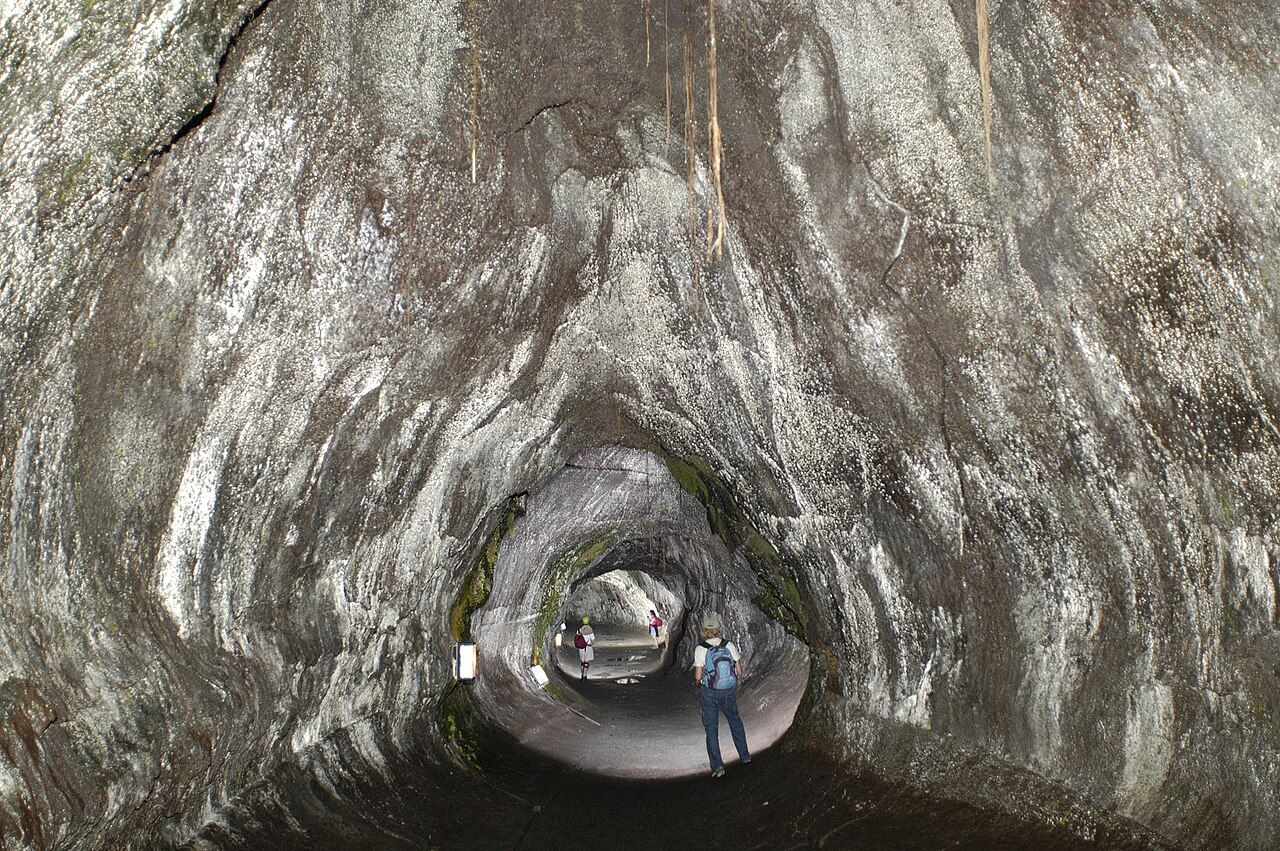
Pāhoehoe is the smooth, fluid kind of lava, and a steady flow can keep moving beneath a surface that’s already cooling. That upper layer hardens into a crust, then thickens as the hot material continues along its channel. The crust becomes a roof; when the eruption ends or the supply shifts, the remaining lava drains away and leaves a passage behind.
Nāhuku took shape roughly five centuries ago, as part of a flow from Kīlauea’s summit area. Along the walls, horizontal shelves mark places where the lava held at one level before falling lower. The ceiling, smooth where molten rock once lapped against it, makes the tunnel’s former life easier to imagine than any grand description could.
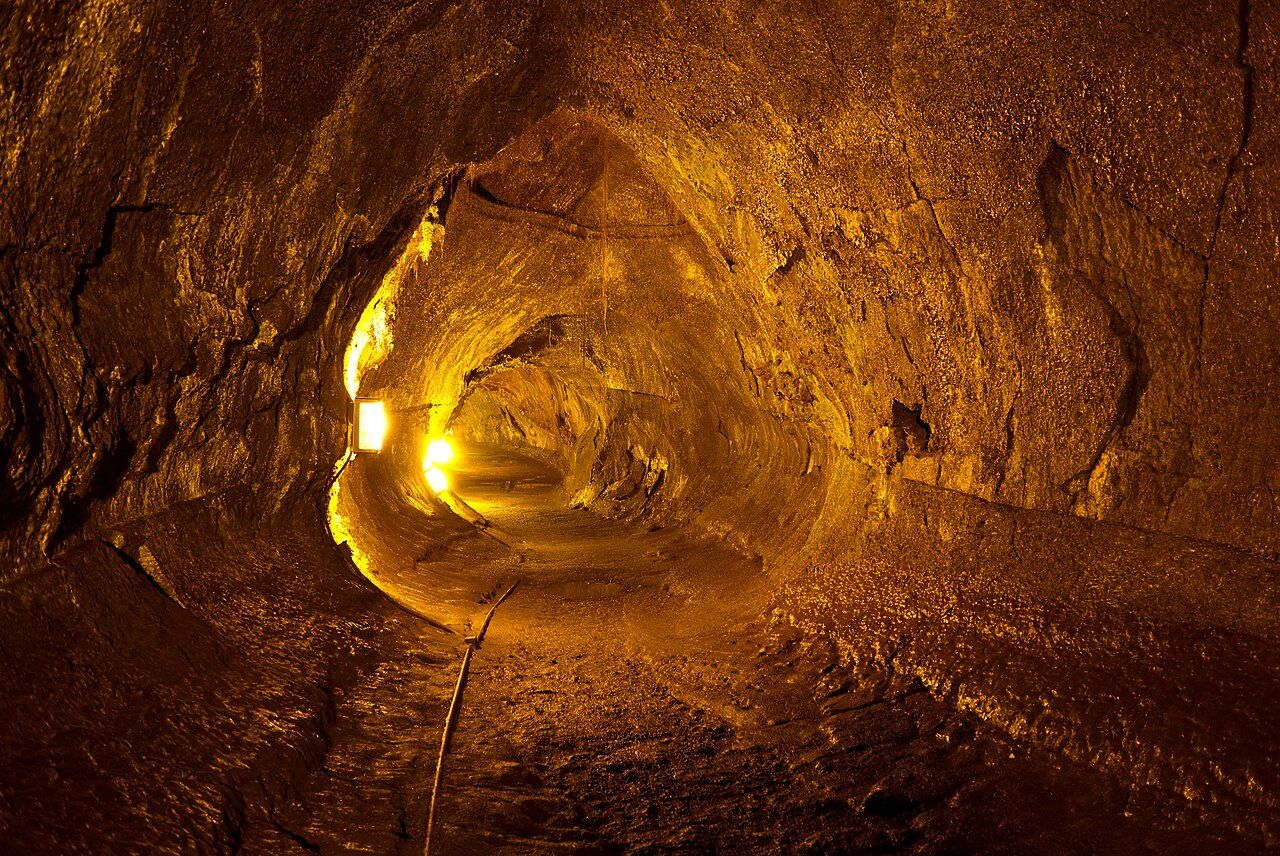

There are lava tubes all over Hawaiʻi Island, some extending for many miles. They carry hot lava a long way from its vent, which helps explain how flows can reach the coast and add new land far from their starting point.
3. What deserves a pause before going inside?
The pit is a small forest in its own right: giant hāpuʻu tree ferns fan out overhead, ʻōhiʻa branches rise behind them, and moss coats the damp surfaces. Rain comes often here, leaving the air moist and the greens layered together. On a quiet morning, the stillness makes even a short pause feel like part of the walk.
Native honeycreepers, including the ʻapapane, feed in the ʻōhiʻa canopy, and their calls carry across the pit. Before the parking area fills, there’s a better chance of hearing those sounds clearly. The story of ʻōhiʻa, ferns and forest birds follows that forest a little farther.
Read next: A walk from forest to lava lake
Tree ferns grow slowly, with dense, fibrous roots forming their trunks. The forest floor is fragile, so the path is the place to stay; leaning on or climbing the ferns would be a poor bargain for a little closer look.
4. What changes once the path enters the tube?
The lit stretch runs level and is short enough to keep the forest close at hand, though the floor can be wet. Rain seeps through rock overhead, tapping down in drops, and fine roots from trees above hang into the passage here and there. Wall lights pick out the roof’s curve and the rock’s gray and brown, with red and orange showing through in places.
The air inside stays cool and steady, a pleasing shift on a warm afternoon. Voices echo in the tunnel, so they travel; I’d rather hear the water dripping than a conversation bouncing off the walls. The cave feels bigger when people leave a little room for its own sounds.
5. Where does the tunnel lead back to?
At the far end, steps climb into the forest, and a path loops around to the parking area. The whole visit takes perhaps twenty minutes to half an hour from car to car, with extra time easy to spend in the fern hollow. It’s a compact walk, but the change from wet greenery to dark stone and back gives it a satisfying shape.
Beyond the way the tunnel was made, there’s a cultural story to keep in mind. Lava tubes around Hawaiʻi Island have been used by Native Hawaiians for shelter, water and burials; many are sacred, and some are protected by law. Nāhuku is open to visitors, but the right approach stays simple: keep voices low, remain on the path, and touch nothing.
Other tubes aren’t necessarily open to the public, and some can collapse, flood or conceal sudden drops. In the dark, it’s easy to lose direction, too. The marked route here is enough; there’s no need to turn a short visit into an exploration beyond it.
6. How does the rest of the day take shape?
By mid-morning, the limited parking can start filling, and it often stays busy through late afternoon as coaches and day visitors arrive together. The quieter windows are before the day gathers pace and during the final hour or two of daylight. Nāhuku is often visited in the morning, when the forest sounds are easier to pick out.
It fits neatly into a summit outing: follow the steam vents and overlooks along Crater Rim Drive, stop at Nāhuku, then carry on toward the summit caldera or down toward the coast. Kīlauea Iki shares a trailhead area, making it another walk to consider in the same part of the park. I’m partial to the contrast between those broad volcanic views and a tunnel whose story sits at arm’s length.
As daylight winds down, the quieter stretch returns. The forest and cave don’t need a dramatic finish; a last look at the lava shelves is quite enough, then the path climbs back toward the road.
7. What belongs in the day bag?
The entrance gets frequent showers, even when the summit is dry, and both the floor and steps can be slippery. A rain jacket, good shoes and a small torch are useful companions. The tunnel’s lit, but a torch can help around corners or for anyone who finds dark spaces uneasy.
- Wear good shoes for the damp floor and steps.
- Pack a rain jacket for showers around the entrance.
- A small torch can help in corners and dark spaces.
- For another walk nearby, read Kīlauea Iki.